

Junior Handler Tatum
Interview with Junior Handler
Q: Please tell our readers how you became involved in the world of dogs and dog showing.
I am a fourth-generation breeder, owner, and handler who has been attending dog shows since a young age. My great-grandmother, Janet Souza, became involved in shows with her American Staffordshire Terriers in 1968. Simultaneously, my grandmother, Linda Souza, discovered her passion for dog shows through Old English Sheepdogs. In 1971, Janet and Linda purchased their first Irish Wolfhound, Ch. Roaree of Limerick, and began breeding under the Limerick prefix. Limerick Irish Wolfhounds have enjoyed great success in the ring, earning prestigious awards such as Best in Show at Santa Barbara, AKC Hound Group Breeders of the Year, and winning the National Specialty. My mother, Jamie, was quickly drawn to shows and continued the family dynasty by breeding Irish Wolfhounds, Whippets, Salukis, and Afghan Hounds. When I came along, it was inevitable that I would follow in their footsteps. My fondest childhood memories are sitting ringside at California shows, watching my mother and grandmother handle Wolfhounds, and soon enough, I began doing the same.
Q: Who were your mentors from the beginning of your dog journey, and do you currently have the same or any additional mentors?
I have been extremely fortunate to have numerous mentors who have played a crucial role in laying the foundation of my handling skills and dog knowledge, but my most prominent mentor has been Alicia Morrison Jones. Alicia happens to be my mother’s best friend and one of the most exceptional sighthound handlers of all time. She excels in her conditioning and presentation of many breeds, especially Afghan Hounds, and has always supported me. Alicia has been watching me ringside since I was a little girl with a dog twice her size and continues to do so now. She provides me with valuable feedback on how I can continue to improve, and I am forever grateful to her.
Q: What breed/breeds have you been involved in handling?
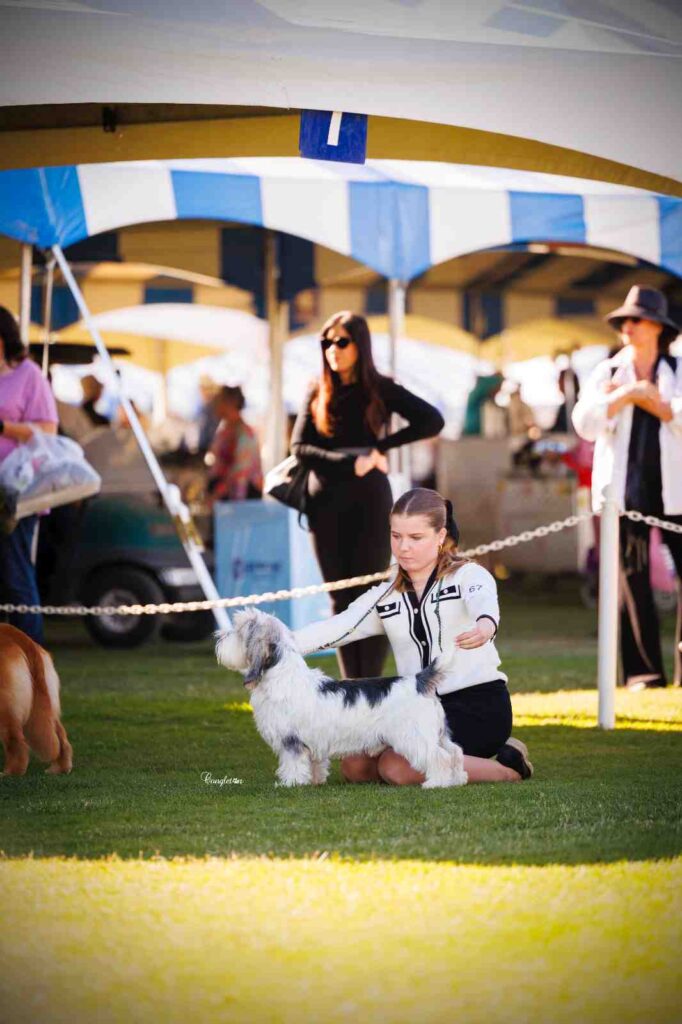
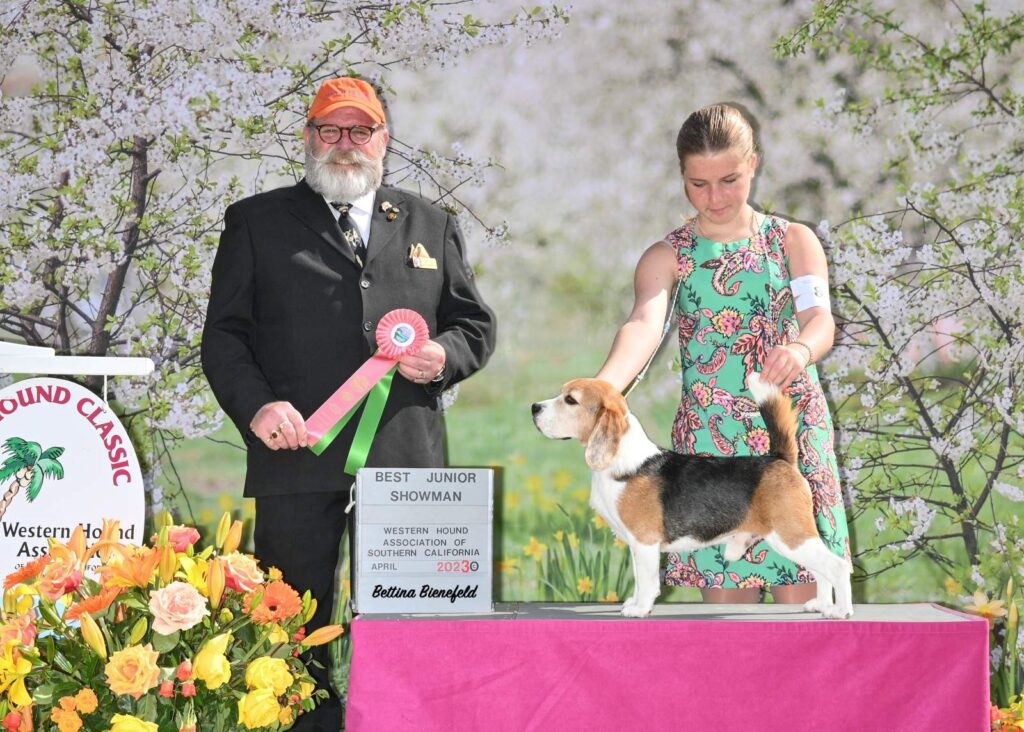
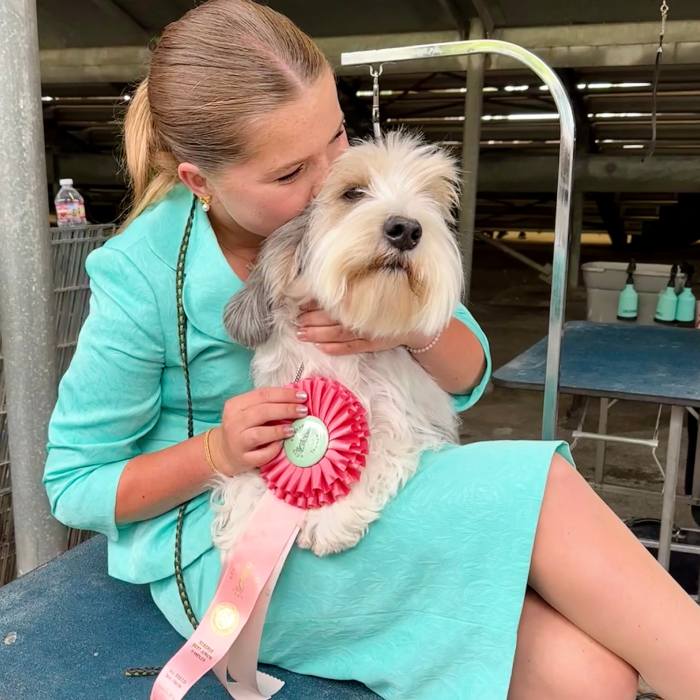
I was born into the fabulous breed that is Irish Wolfhounds, but from a young age, I was always captivated by Beagles. I have two wonderful Beagles at home, Disney and Gilbert, whom I have shown to multiple titles. Last year, I was fortunate enough to show Venus Flytrap, the Ibizan Hound, at Westminster and Royal Canin. Recently, I was blessed to have Janice Hayes trust me to take the lead of a Petit Basset Griffon Vendeen, Spotify. We just started together in January and have had incredible success in the Juniors ring as a team. Apart from my beloved Hounds, I have gained a lot of experience with a variety of breeds from working for Amy Rutherford for the past three years, especially Terriers. I adore their showmanship and spunky personalities. Working for a handler is the best thing a junior can do. You have the opportunity to get your hands on new breeds and become educated about their grooming and presentation. Through working for handlers, I have shown breeds in every single group.
Q: Do you currently breed, and is this something you see yourself doing in the future?
My family has bred top-winning Irish Wolfhounds, and I was fortunate enough to be present when Limerick’s last homebred litter hit the ground. In the near future, I am hopeful for my first litter of Limerick Beagles. I plan to continue breeding for the rest of my life and consider it the most important component of our sport.
Q: What, in your words, is the purpose of dog shows?
Dog shows provide a platform for breeders to showcase their dogs and for judges to evaluate them against the breed standards. This helps maintain and improve the quality of dog breeds by rewarding those that best represent the breed standard. Dog shows can also educate the public about different dog breeds, their characteristics, their preservation, and their suitability as working dogs or beloved pets. Additionally, dog shows serve as a discussion space for breeders to collaborate, educating one another on standards, breeding best practices, and health issues and concerns. Ultimately, dog shows foster a tight-knit community.
Q: Do you find it difficult to balance personal, school, and dog show life? How do you make time to fit everything in?
School has always been and will always be my top priority. I attend school in-person and rarely miss school for shows. Because of my school’s rigor, it is important that I complete my work before I leave for shows. This allows me to fully immerse myself in the show without feeling overwhelmed by my schoolwork. I typically attend one or two show weekends a month, which allows for a good balance between shows, sports, school, and spending time with friends while still maintaining the high-quality schoolwork I demand of myself.
Q: What profession would you like to have as an adult?
I aspire to become a veterinarian, specifically focusing on theriogenology.
Q: Do you prefer handling table dogs or larger dogs?
Coming from a family that primarily works with larger breeds, I’ve gained extensive experience handling stubborn, larger dogs. However, my fascination with smaller hounds has also led me to become proficient in presenting table dogs. To me, both experiences are equally enjoyable, so I don’t have a preference.
Q: Is there a certain coat you prefer to prepare for the ring?
While I have experience with a wide range of coats, from Poodles to Beagles to Terriers, I’m particularly enamored with the coat presentation of the Petit Basset Griffon Vendeen. I adore their rustic coat appearance, as stipulated by the standard.
Q: What professional handlers or owner handlers inspire you?
Our sport boasts numerous inspirational breeders, owners, and handlers, but I’d like to highlight Patricia Trotter, as well as Luke and Diane Ericht. Pat Trotter has been an idol of mine for as long as I can remember. Her unparalleled success with Vin-Melca Norwegian Elkhounds and her comprehensive knowledge of all breeds make her an icon in the sport. Luke and Diane Ericht have long been role models, particularly for their remarkable achievements with their Hallmark Jolei Shih Tzus. Witnessing their own Comet rise to the top last year, especially as a breeder, owner, and handler, was truly astounding.
Q: If you could be an assistant for any handler, past or present, who would it be, and what would you hope to learn from them?
I believe I am currently in the ideal position. I currently work for both Amy Rutherford and Janice Hayes, and I am immensely grateful for their guidance and mentorship. Amy and Janice possess an unmatched wealth of knowledge in grooming, handling, and animal husbandry. Their exemplary work ethics serve as inspiration to me. By working with Amy and Janice, I am also benefiting from the collective experience of all those they have learned from.
Q: What dog from any point in time do you wish you could handle and why?
Choosing just one is incredibly tough, so here are three dogs I’d be thrilled to handle: Mick the Kerry Blue Terrier (CH. Torum’s Scarf Michael), expertly presented by Bill McFadden. Mick embodied the breed standard with his classic Terrier edge and spirit. I’d also love to handle Miss P the Beagle (CH. Tashtin Lookin for Trouble), flawlessly guided by Will Alexander. Peyton was a spectacular Beagle, and as a Beagle enthusiast myself, seeing her beauty recognized was truly inspiring. Lastly, I’d be honored to handle Boomer the Standard Poodle (CH. Hallifax Hightide Hedonist at Afterglow), showcased beautifully by Jason Lynn. Witnessing Boomer’s undeniable beauty and showmanship at Westminster was unforgettable.
Q: Do you show your own dogs in breed competition, and if so, what breeds?
Primarily, I showcase my Beagles and Irish Wolfhounds in the breed ring. It’s a privilege to present dogs that exemplify the breed standard in various aspects to the fancy.
Q: What have been some of your greatest achievements in the breed ring?
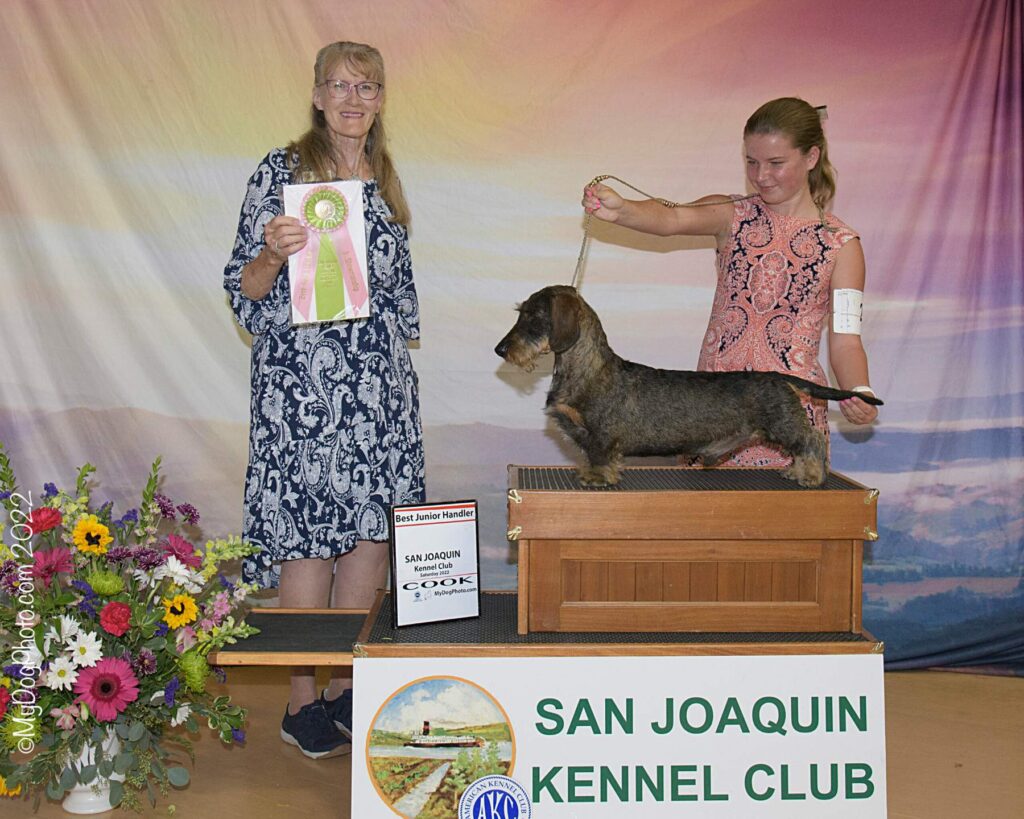
While I’ve had the opportunity to show numerous dogs in breed competition, I’d consider my greatest achievements to be with my Irish Wolfhound, Winn, and my Wirehaired Dachshund, Garrus. I guided Winn as a puppy to three consecutive major wins over a significant specialty weekend, securing his championship—a challenging feat considering I was just twelve years old, handling a dog outweighing me by one hundred pounds! Garrus, my Wirehaired Dachshund, has brought me the most success in the breed ring, earning several group placements, including a memorable Group Second under Dachshund authority, Mr. David Peat.
Q: If you couldn’t show your own dogs, what handler would you choose to show them?
I’d entrust Taffe McFadden to showcase my dogs. I admire her gentle touch, subtle style, ability to connect with her dogs, and how she gracefully fades into the background behind the dog she’s handling. The finest handlers are those who shine the spotlight on their dogs while remaining unassuming themselves, and Taffe embodies this skill effortlessly.
Q: What is your favorite show of the year to attend, and why?
My favorite shows are the Kennel Club of Palm Springs and the Westminster Kennel Club. Palm Springs is an exceptional way to kick off the year. The club puts on an excellent show with well-kept grounds, large entries, and outstanding hospitality. And Westminster, there truly is no other show like it. The electricity, the anticipation, and the prestige all contribute to making it a highlight of the year.
Q: Have you been to any shows outside of the USA, if not, would you like to?
I had the opportunity to attend a dog show in Wales while my mother was judging Hound breeds. It was fascinating to experience the differences in environment, ring procedures, and breed types of dogs. I look forward to attending more shows outside of the US in the future.
Q: Is there anything you wish judges understood more when it comes to judging Junior Showmanship?
I wish judges took into consideration the specific handling required for certain breeds. For instance, some breeds do not excel in free stacks, while others have particular aspects that need to be accentuated through different showing techniques. It’s important not to discount a junior for showing their breeds correctly according to the standard. However, it’s understandable that not every junior judge has comprehensive knowledge of each breed’s standard and handling nuances.
Q: Junior handlers are the future of the sport. Do you feel, in general, that you and other Juniors are treated with the respect you deserve to inspire you to stay in the sport?
As a junior, I’ve generally felt respected by fellow juniors and the adults in the sport. My family has always emphasized the value of sportsmanship, which helps foster mutual respect between myself and other exhibitors and juniors at shows.
Q: Do you have any pastimes outside of the world of dogs?
Outside of the ring, I play Field Hockey and Lacrosse for my high school, hold a scuba diving certification, spend summers in the natural landscapes of Wyoming, and ski at Jackson Hole Mountain Resort with my family.
Q: What are your own personal future goals in the world of dogs?
My primary goal is to continue preserving my breeds by breeding healthy dogs that are sound in body and mind. When I age out of juniors, I hope to obtain my judging license for Junior Showmanship to give back to a program that has given me so much. Additionally, I aspire to judge regular competitions and be known for fairness and insightfulness.